Why digital mail is the cheapest and most lucrative revenue stream for coworking spaces

Many coworking operators hear "new revenue stream" and translate it to "new line item."
That instinct comes from experience.
After all, most services you've added to your workspace arrived with a bill for build-out, furniture, software, staff hours, or marketing.
So, when someone suggests adding a service like digital mail, your natural first question is, "What will this cost me?"
The better questions to ask are, "How much will this pay me, and how much do I have to spend to get it?"
The answers to both might surprise you.
iPostal1 partners have earned more than $150 million from a service that needs no square footage
Digital mail is one of the rare workspace products that isn't tied to a desk, an office, or a lease.
Customers pay you a monthly subscription for an address and the ability to manage their mail from an app, and most of them never set foot in your building.
That model has produced significant revenue for our partners: iPostal1 has sent more than $150 million in commissions to a network of 4,250+ locations.
After 18 months, the average workspace has more than 60 active customers, and industry research on coworking's most scalable revenue lines puts average revenue per digital mail customer at $25 to $50 per month.
This is incremental income with no acquisition costs or administrative work beyond the 30 minutes per day.


Many of our workspace partners are generating success well beyond the average.
NYC Office Suites COO Hope Landry runs seven centers with one person at each front desk and generates roughly $120,000 a year from digital mail.
Her assessment: "It's almost pure revenue, aside from whatever you pay a support person. There's really no overhead."
Perfect Office Solutions built a $110,000 per month digital mail revenue stream across more than 20 locations without hiring a dedicated mail team.
Founder Chiko Abengowe equipped his community teams with iPads, gave them a 5% revenue share on the digital mail accounts they manage, and let the incentive drive the growth.
The Farm started digital mail at 2% of revenue.
Six years later, it accounts for roughly 30% of the company's total revenue across three locations in San Francisco and New York, and founder Lucas Seyhun says that at the San Francisco location, iPostal1 has outgrown every other revenue partner they've worked with, including advertising.
Those are the returns. Now, let's look at what they cost.
85% of workspace customers choose a business address, and you receive the $5 premium
Before we get to expenses, one more number on the revenue side deserves attention, because it changes the per-customer math.
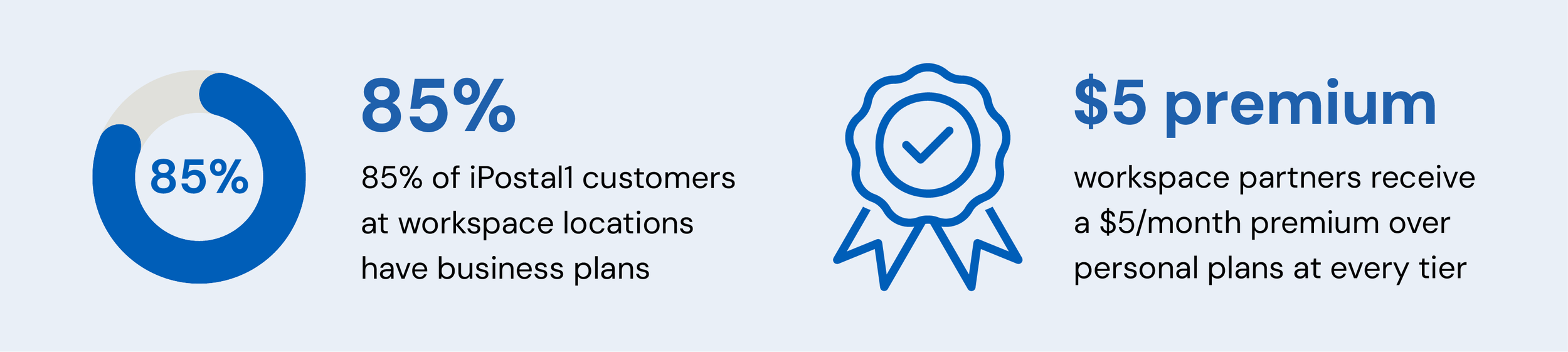
Since customers choose their locations, the ones who choose workspaces also tend to choose business plans. Moreover, they tend to choose annual plans because they’re committed to their long-term goals for their business.
This results in longer-lasting, higher-value customers.
The premium does two things at once:
It lifts your commission on almost all of your iPostal1 customers
It brings iPostal1 pricing much closer to the rates operators already charge for their own virtual office services, so the two revenue streams read as one coherent offering rather than a discount product sitting next to a premium one
In practice, that means the customers we send you are paying business rates, and you're being paid business rates for serving them.
With iWorkSpaceMail, you set the price and keep the revenue
The typical pricing concern we hear with digital mail has a second half, and it usually sounds like this:
"I don't control what iPostal1 charges, so I don't control my margin."
iWorkSpaceMail provides the counterpoint: it runs on the same platform, with the same daily workflow, but it serves your own virtual and office members instead of customers from iPostal1.
You set the pricing, invoice your members, and pay us a small, fixed monthly fee per user while everything else belongs to you.
Operators tend to structure it in one of three ways:
Bundled into memberships: Digital mail is included in every office and dedicated desk plan as a standard amenity. This is where we see partners experience the greatest success because it’s simple to build in, and is especially effective in the hospitality-oriented coworking industry since it can be positioned as another valuable amenity.
Flat monthly add-on: Members pay a fixed fee to add digital mail to any existing plan.
Subscription plus task fees: Members pay a monthly rate and individual fees for scans, forwarding, and other requests.
All three work, and the 85% business-address figure gives you a ready-made benchmark for what members will pay, because those iPostal1 customers are already paying business-address rates for the same service at your location.
This has been demonstrated by real coworking operators.
ALX Community took the boldest route.
They included iWorkSpaceMail free in their office and dedicated desk memberships and still came out ahead, because their iPostal1 commissions more than covered the cost of offering the service to members.
Their virtual office membership grew so popular that they paused new signups at their flagship location for lack of capacity.
Community Manager Luke Powell put it bluntly: "If you're running a coworking space and you're not offering digital mail services, you're leaving money on the table."
Vast Coworking, the largest privately owned coworking franchisor in the world, reached the same conclusion from the franchise side.
Their operations leaders explain why bundling digital mail into membership packages lifts revenue, retention, and efficiency, and the core insight is that members who get a package built around their needs stay longer and buy more over time.
Getting started costs: a filing cabinet, a smartphone, and quick set-up and training
Here’s the part operators expect to hurt, and it doesn't. To launch digital mail with iPostal1, you need three things:
A filing cabinet to store mail and a shelf for the occasional package
A smartphone or tablet to photograph incoming mail, or a desktop scanner if you prefer one
Registered CMRA status with USPS, which our compliance team helps you secure
That’s the complete list, with no build-out, additional square footage, or new hire behind it.
Training and onboarding are also free (and so is training new employees, in perpetuity).
Our team walks you through the platform in a one-hour session, and most workspaces are processing mail shortly after signing on.
iPostal1 carries the marketing, billing, support, and compliance for you
The costs that sink most new service lines show up after launch:
Customer acquisition
Billing
Support
Chargebacks
Compliance paperwork
Each of these could consume a full-time role on its own, but with iPostal1, none of them land on your desk.
Here’s what we handle for every partner:
Customer acquisition: We invest heavily in marketing, SEO, and advertising to drive traffic to iPostal1.com, where your location appears with your photos and features. Your acquisition cost is zero.
Payments, refunds, and chargebacks: Our billing team charges customer accounts, processes payments, and manages disputes.
Customer service: A dedicated team supports your digital mail customers with questions and account issues.
Compliance review: Our CMRA support team reviews the Form 1583 and IDs for every new signup, so your only job is to approve the customer.
The acquisition piece is what makes the biggest difference when it comes to costs.
When Lucid Private Offices looked at their own acquisition math, they were paying $60 to $80 per click on Google to reach prospects.
iPostal1 now sends customers to Lucid's community teams without adding to their workload, and 80% of the virtual clients we send to partners come from other cities, states, or countries.
Those are customers your local marketing would never reach at any price.
100 customers take 30 minutes a day, and half of them never receive mail
Money is only half the concern for most operators. The other half is the fear that digital mail will turn into a second job for a community manager who is already stretched.
Our partner data says otherwise.
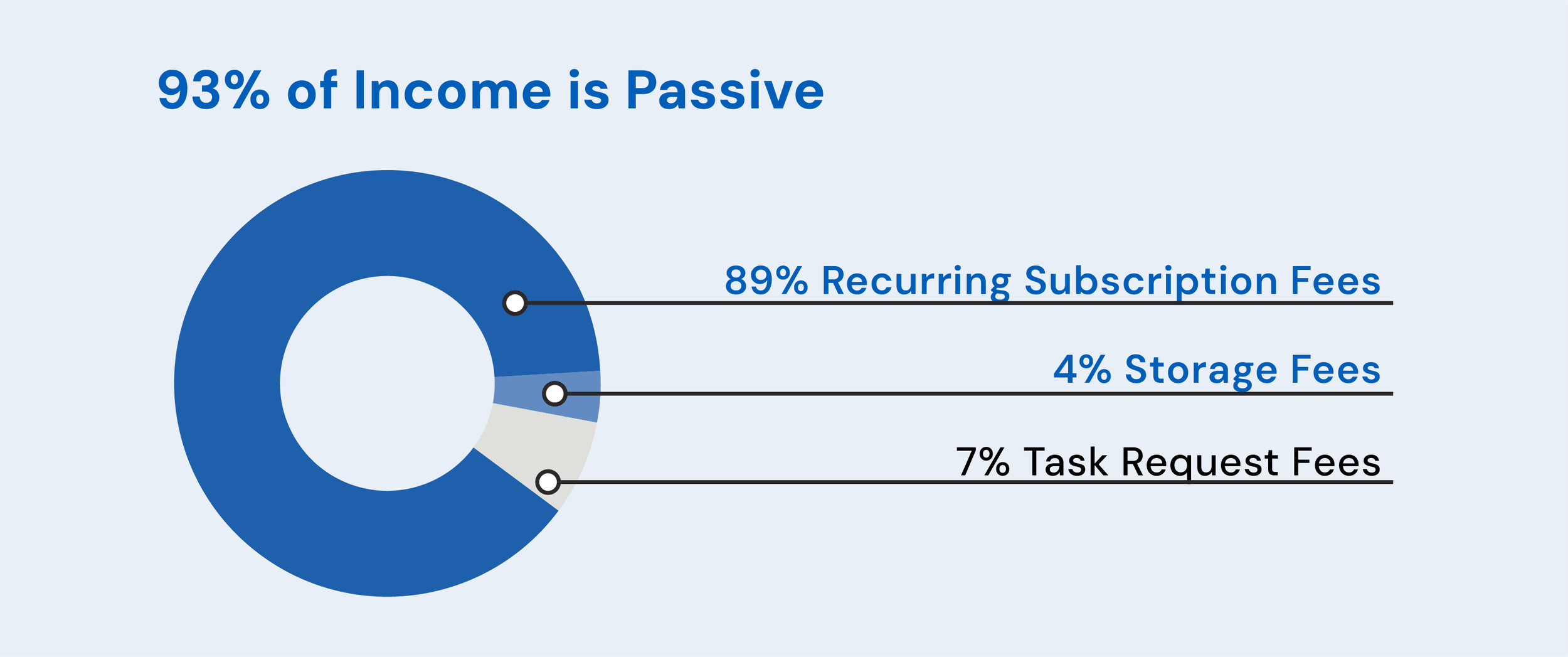
Lucid runs its locations with one or two people on site, and mail from iPostal1 customers takes them 15 to 30 minutes a day.
Director of Operations John Egan summed up the economics in one sentence: "If half your users don't even need help and you're still getting paid, why wouldn't you do it?"
Your offices hit a ceiling, but digital mail keeps growing
Every desk, office, and meeting room you own has a ceiling. Once they fill up, revenue stops growing until you sign a bigger lease, hire more people, or open another location.
That’s an expensive way to grow, and it’s the only way to grow if space is your only product.
Digital mail has no ceiling.
Lee Anderson, owner of Office Evolution Blue Bell, kept growing his mailbox business after his offices reached full capacity.
As he puts it, "As long as you have the right processes in place, you can continue growing the mailbox business without being constrained by the size of the building."
None of the operators in this article spent their way to their results.
They said yes to a drawer, a tablet, and thirty minutes a day, and the revenue built from there..
What digital mail costs, and what it pays back
The pricing concerns among operators rests on an assumption that the numbers don't support.
On the return side:
Our partners have earned more than $150 million
The average location has 60+ customers paying $25 to $50 a month within 18 months
85% of the customers we send to workspaces choose business addresses that carry a $5 premium to you
iWorkSpaceMail lets you set your own pricing for your own members
On the cost side, you need a filing cabinet, a device you likely already own, and about 30 minutes a day, while marketing, billing, support, and compliance are handled for you.
The operators featured here ran the same math you're running now and reached the same conclusion:
The cost is small, the upside potential is significant, and waiting is the most expensive option.
Ready to get started with iPostal1? Contact us today to start building a new revenue stream for your workspace with digital mailbox solutions.